


Bovone Robotic System: Bovone’s integrated robotic system for the automation of grinding processes.
Bovone’s fully automated robotic islands are the perfect solution for automating grinding processes and optimizing production in your company. The robotic integration of edging machines with multi-axis articulated robots allows a considerable increase in productivity, with lower costs and greater safety for the operator in the handling of large slabs.
The system meets Industry 4.0 protocols
The islands work without the presence of personnel and are fully connectable for traceability and self-adjustment of production parameters.
Bovone technologies are the result of constant research and development work in Industry 4.0
Strengths
- Automation, traceability and production monitoring
- Gripper with reduced weight and dimensions weigh less on the load capacity of the robot for a lower consumption of energy and lower cycle time
- Increased productivity in edge processing processes
- Customization of the system according to customer needs
Bovone’s fully automated robotic islands
are the perfect solution for automating grinding processes
and optimizing production in your company.

The integration of robots within lines of grinders brings enormous advantages:
- Unprecedented productivity
- Greater operator safety
The edgers can be placed side by side with a single robot or configured according to customer requirements, in a high-productivity robotized cell, consisting of two grinding machines with automatic wheel increase and two robots.
The ELB range is now integrated in robotized lines, in favour of safety and productivity only from bovone
no operator needed
Following the market demand for more and more automation to increase production or for safety reasons (handling large glass slabs), Elettromeccanica Bovone has expanded and integrated its range of products offering Robotic Systems.
Robots can be supplied as stand-alone, applied to existing grinding machines or as customized islands composed of two machines and two robots, working without any operator.
High-load applications

Bovone has designed and developed grippers characterized by reduced weight and overall dimensions. This peculiarity allows to weigh less on the loading capacity of the robot itself; in this way it is possible to increase the performance with time and energy savings during the processing cycle of particularly heavy slabs.
Compared to other equipment of this type there is up to a 25% time saving, with an increase in overall safety.
The lines are composed of modules that can be integrated
THREE GOOD REASONS for choosing the Bovone Robotic System
SAFETY AND RELIABILITY
The use of robotic elements, produced by companies rooted in the market, ensures safety and reliability even on after-sales service.

PRODUCTION PERFORMANCE
The robotic integration allows a considerable increase in productivity, with lower costs and greater safety for the operator in the handling of large slabs.
TECHNOLOGY AND INNOVATION MADE IN BOVONE
The development of grippers designed with reduced weight and size enhances performance by saving time and energy during the processing cycle (up to 25% less than similar equipment).

GLASS LOADING ZONE
This is considered the starting area of the system where the operator will load the glasses to be processed. He can use a bar code reader to insert in the program the glass dimension and the processing sequence, or he can do this operation manually. The glass rack can be positioned on a turning table so that two racks can be used: while the operator is loading one rack and inserting the processing sequence, the robot can load the system using the rack on the opposite side.
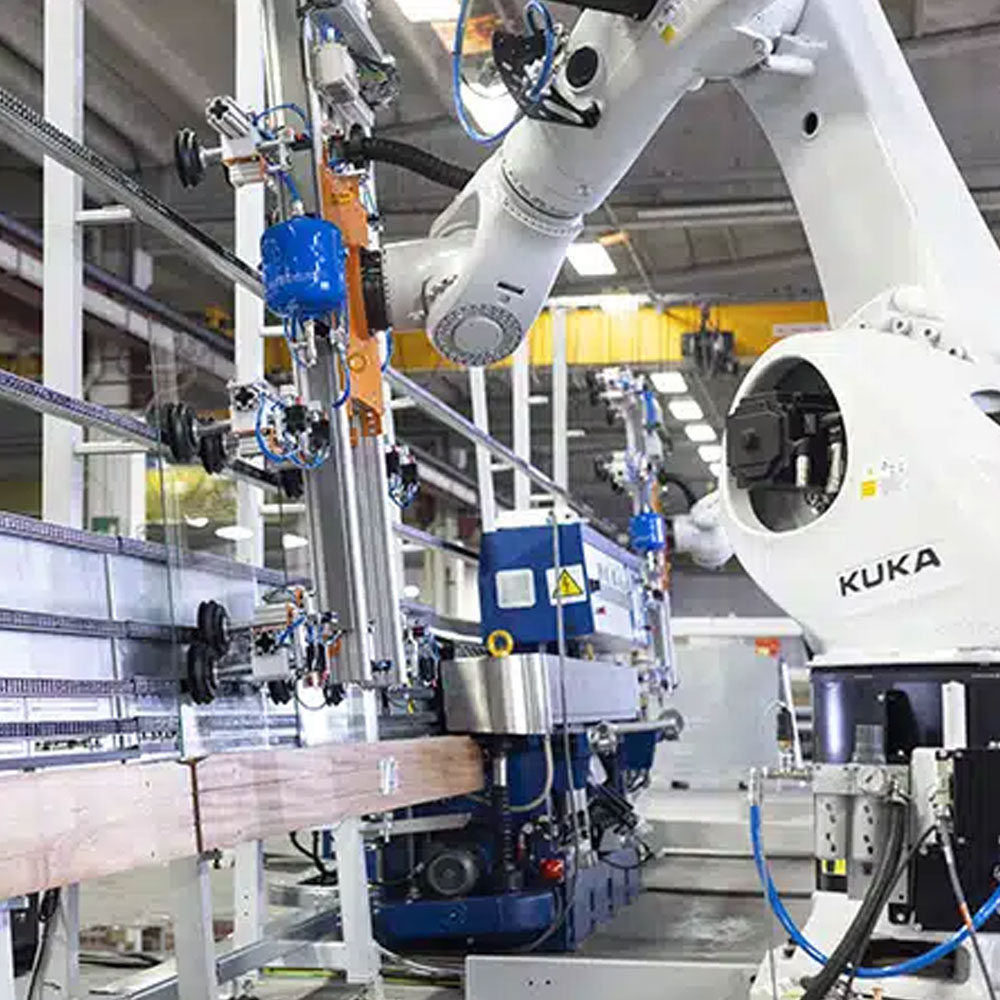
FIRST ROBOT
This robot has different tasks inside the system process:
- Loading the glass on the first edger
- It can take the glass coming from the second edger, rotate it and load it again on the first edger in order to process all four sides
- It can take the glass out from the second edger and off load it when the glass cycle has finished
If after the second edger is installed another machine to further process the glass (i.e. washing machine, hole drilling etc.) the robot can either off load or not the glass, depending which operation is needed on the glass.
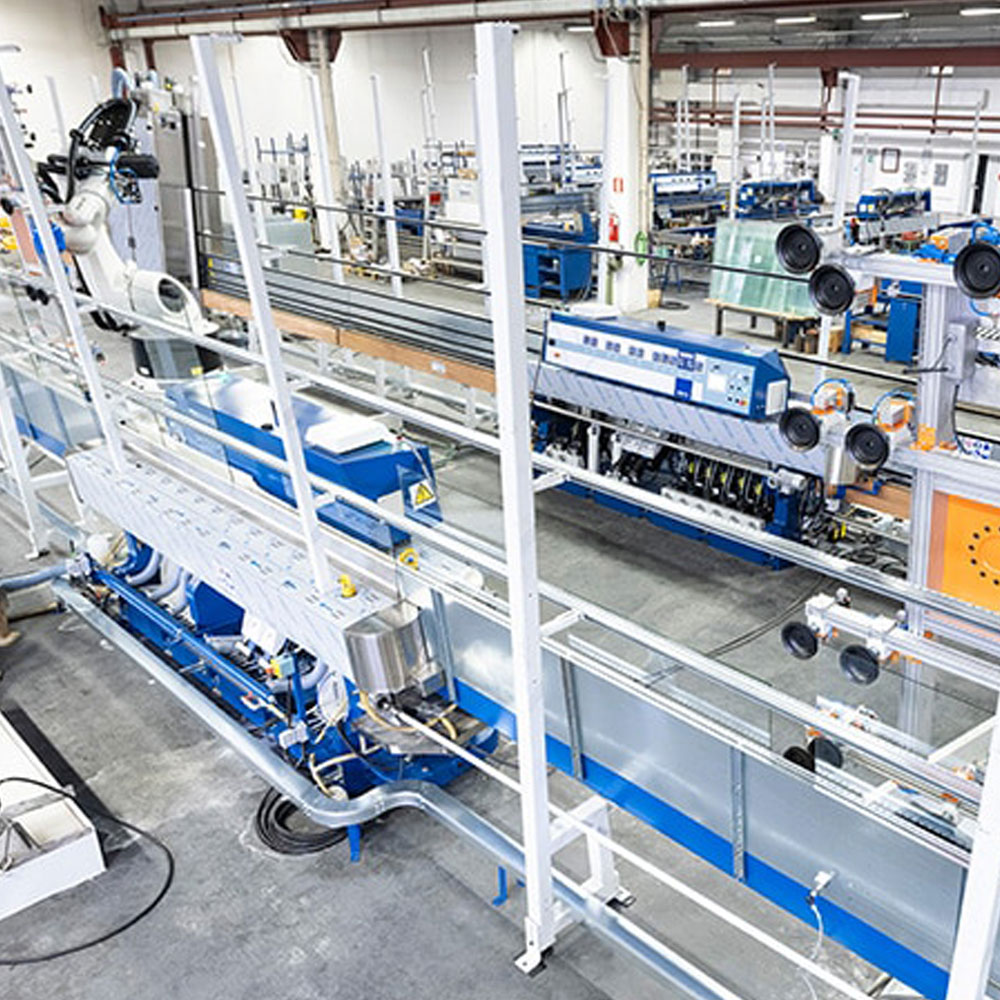
STRAIGHT EDGE POLISHING MACHINES
The configuration of the robotic system involves the installation of two edgers facing each other for processing the edges of the glass. The installed edgers are of the Fully Automatic type: all adjustments are made automatically according to the recipe uploaded by the operator and the spindles rise automatically to compensate for the wear of the wheels during processing. The edgers can work at very high speeds, above 5 m / min, thanks to robotic loading and unloading.
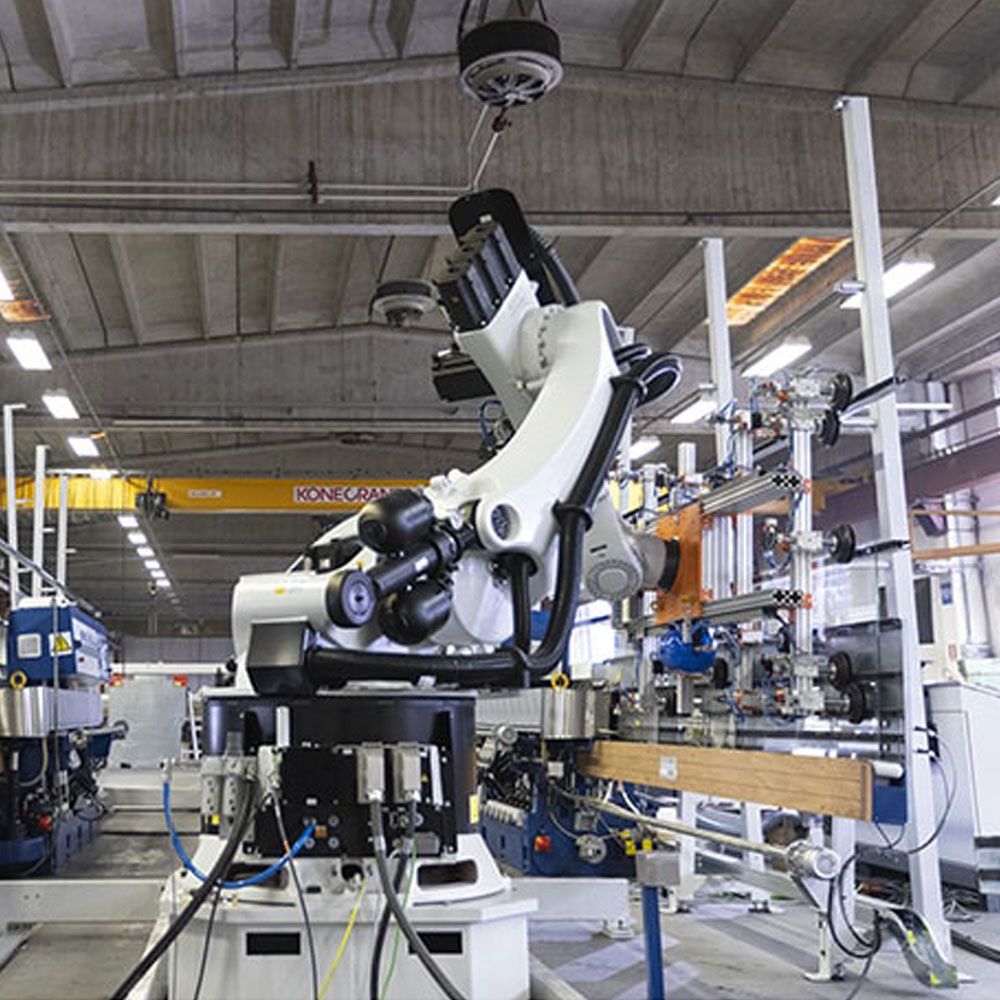
SECOND ROBOT
This robot works out of the first edger and can perform two different operations:
- It can rotate the glass 90 ° or 180 ° depending on the required processing and load the glass on the second edger;
- It can carry out the unloading of the glass in case it has to be processed on an odd number of sides.

ADDTIONAL PROCESSES
Further machines such as washing machines, drilling machines etc. can be installed in line at the exit of the second edger. The BRS robotic systems are highly configurable and can accommodate different machines according to the customer’s needs. In this layout, a BVR washing machine was installed to clean the glass coming out of the process.
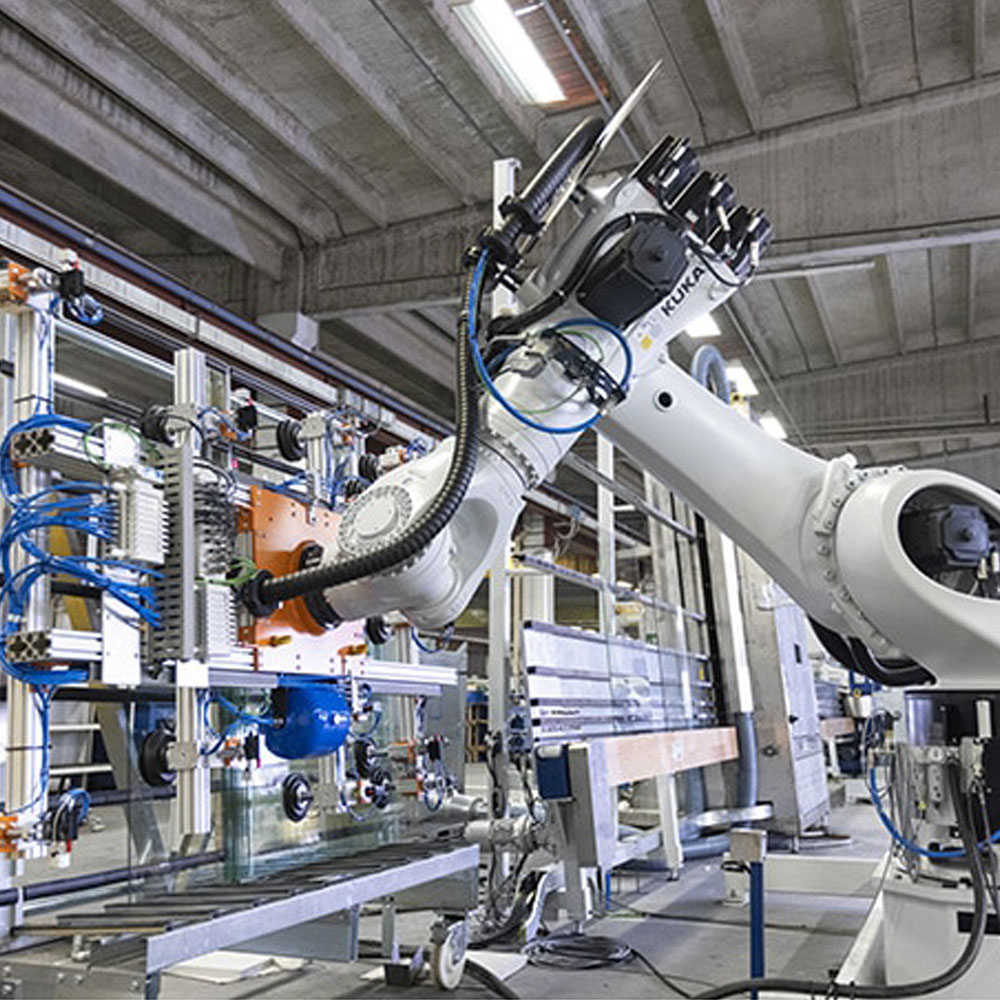
THIRD ROBOT
This robot only performs the unloading of the line on the rack. As for the loading, the unloading can also be configured with a turntable where two racks can be placed, one on which the robot will unload and the other outside where the operator can unload the line.