


Reliability, productivity and versatility in glass laminating processes
- Automatic and semi-automatic lines to meet customer needs
- Straight and U-shaped configurations to adapt and exploit spaces
- Unwinding section and PVB magazine (STD 6 optional 8)
- Glass and PVB panel with thickness up to 80 mm
- Maximum processable width: 1600, 2250, 2600, 3300 mm
- Maximum glass length: 3300, 4500, 5100, 6000 mm
- Panel traceability
Versatile as ever
they guarantee excellent performance both in the production of large numbers and for those where high flexibility is required between one batch and another.
The most reliable ever
with minimal maintenance, there are very few and short machine downtimes. They guarantee high precision and quality of the finished piece and, also by virtue of the high degree of automation, contribute to an increase in plant productivity. They can be integrated with robotic elements, configured in autonomous islands.
Totally customizable
Bovone’s complete plants for glass lamination are totally customizable and integrable according to the specific needs of the customer: all the construction details can be customized and calibrated to meet any specific requirement.

Bovone propone forni ibridi HRC integrati nelle linee complete di laminazione ed EVATHERM, la soluzione stand-alone sviluppata per la laminazione con film EVA.
BOVONE’S GLASS LAMINATION OVENS ARE DESIGNED TO MEET THE NEEDS OF THE WIDEST RANGE OF PRODUCTION APPLICATIONS.
- Thermal Uniformity and Process Quality
- Energy Efficiency and Reduced Consumption
- Flexible Configurations for Different Production Needs
- Operational Reliability and Ease of Management
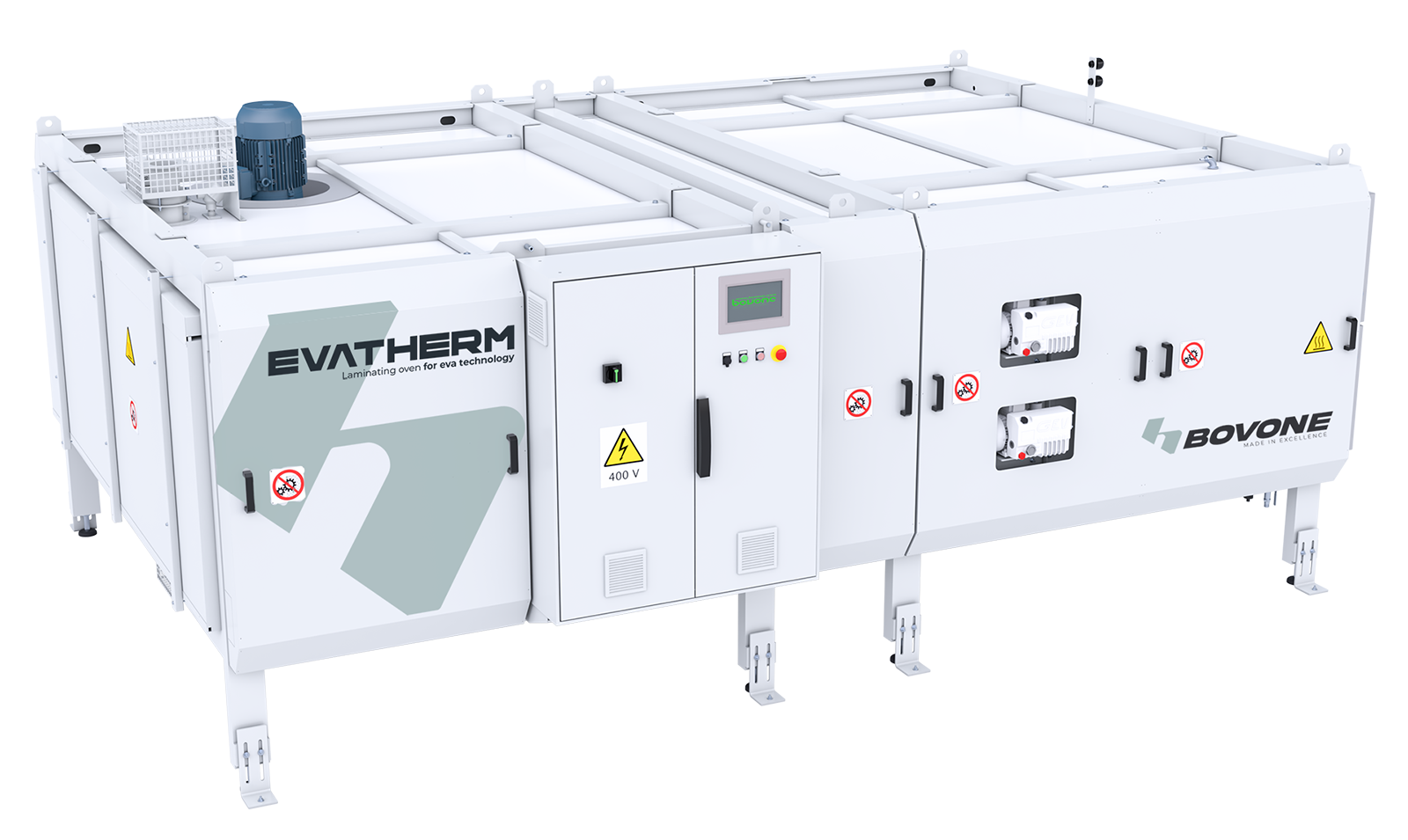
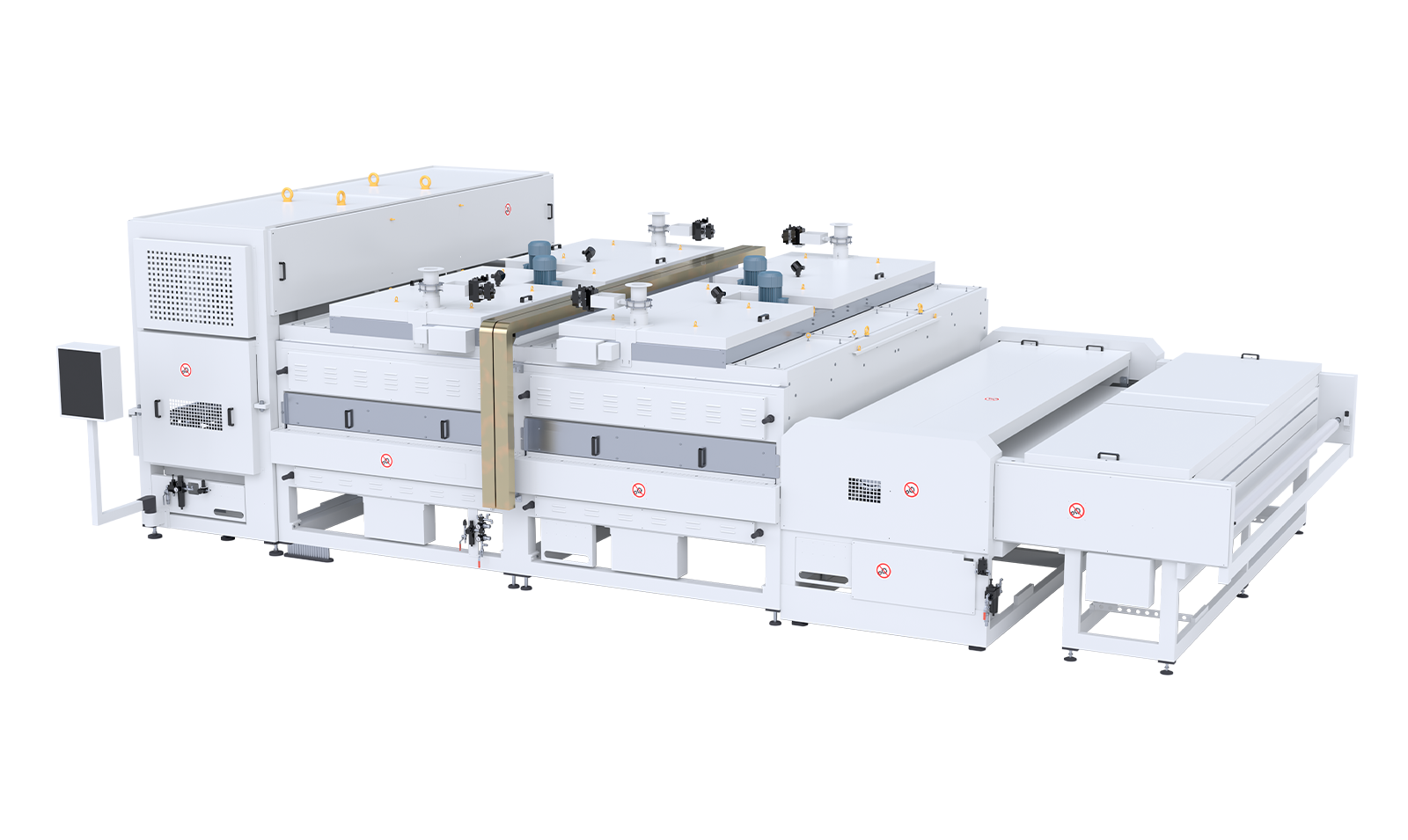
The application sectors of construction, architecture, automotive and transport in general are constantly evolving in line with the trends of an increasingly complex and frenetic global market. Laminated glass is widely used in these sectors by virtue of its important functions in terms of safety and comfort – thanks to its high thermal and acoustic insulation capacity – as well as its non-negligible decorative potential.
With the new Bovone Hybrid technology, the hot air convection system frees itself from the use of lamps: the air, in fact, is heated by a resistance system inside the oven. The new furnace manages the materials by integrating two completely independent heating systems, which can be combined with each other depending on the needs. The two systems, in fact, can be managed in different ways: the control panel is very simple and intuitive and allows you to access a wide variety of settings – including the independent management of each single IR lamp – very easily, also guaranteeing less experienced operators excellent results right away.
The lines are made up of integrable modules
The lines are made up of integrable modules
CUSTOMIZATION OF THE LAYOUT
The Bovone laminate lines can be configured on different layouts suitable for the available work spaces, from the U-shaped position to the one developed completely in length.

MODULARITY
The interchangeability of the integrated components allows you to purchase a highly customized product tailored to the specifications of each individual buyer.
A Bovone line grows with the user, who can integrate it with new modules (including robotic ones) and reconfigure it over time.
VERSATILITY
Ideal in the production of safety glass, both for interiors and exteriors, and can be used both on mass productions and of particular shape and quality.
LOADING
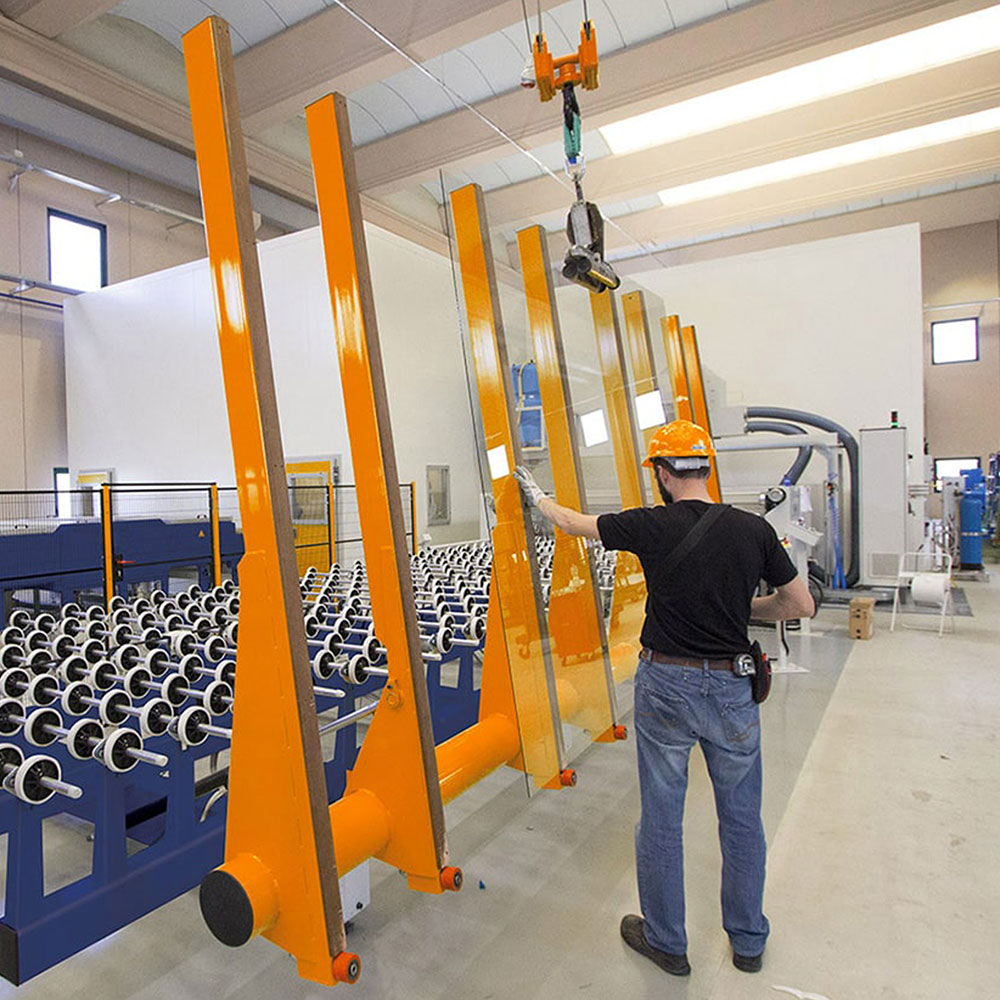
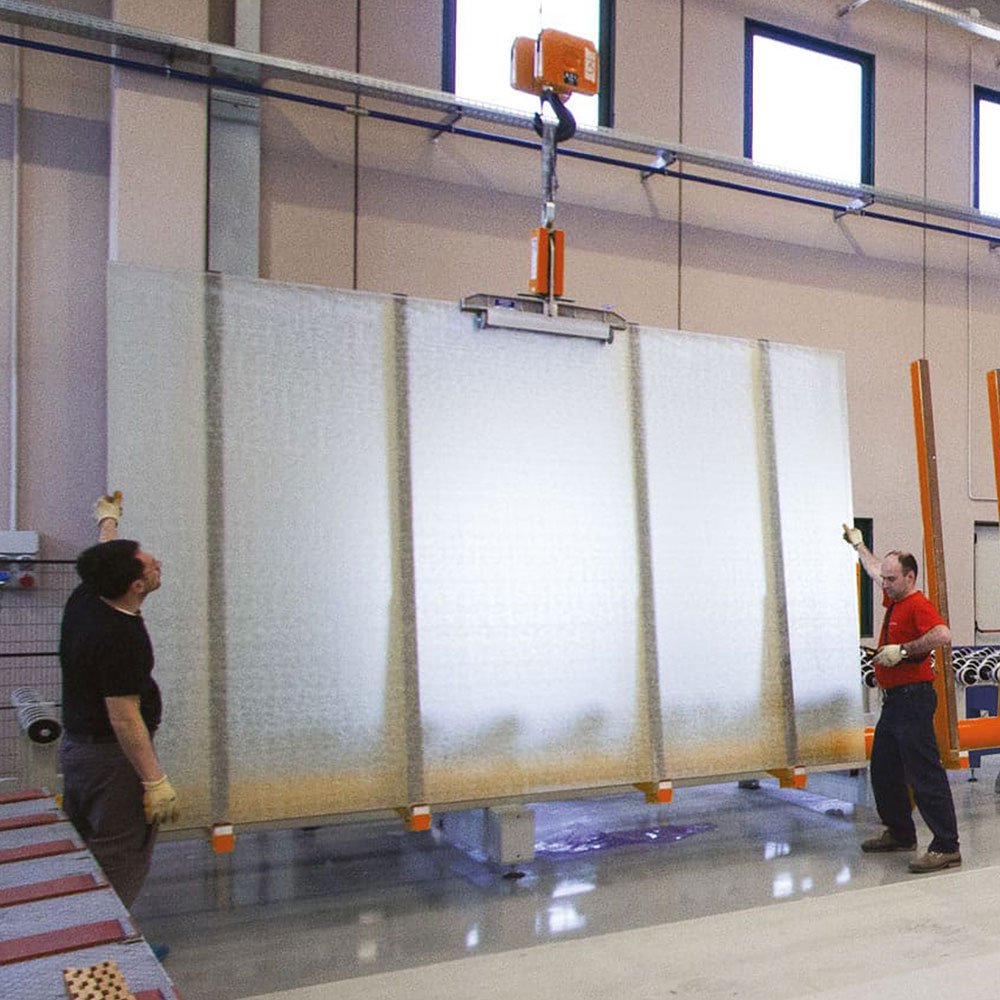
This is the initial area where the glass is loaded. This phase can be carried out manually or automatically, for example with the help of a robot. Loading can take place horizontally or vertically: this depends on the chosen configuration and the space requirements. A line with a vertical load takes up less floor space than a horizontal load.
WASHING
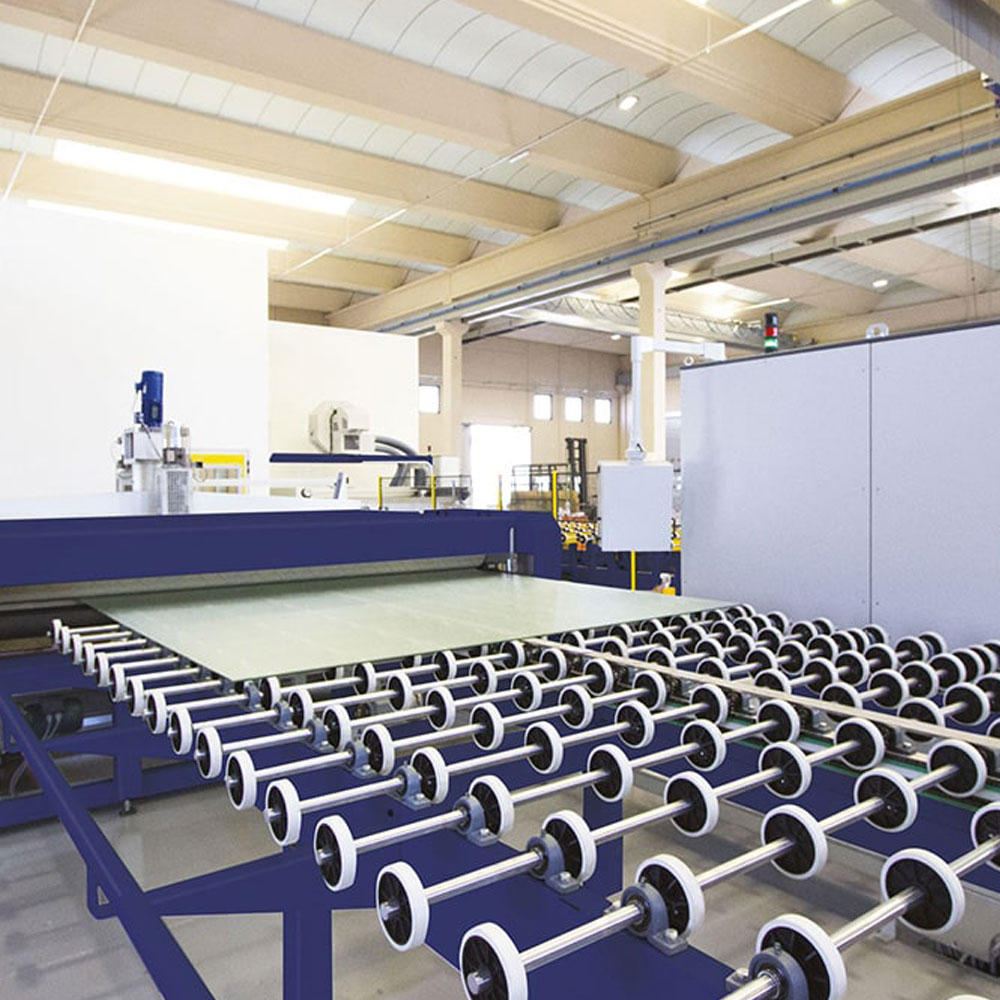
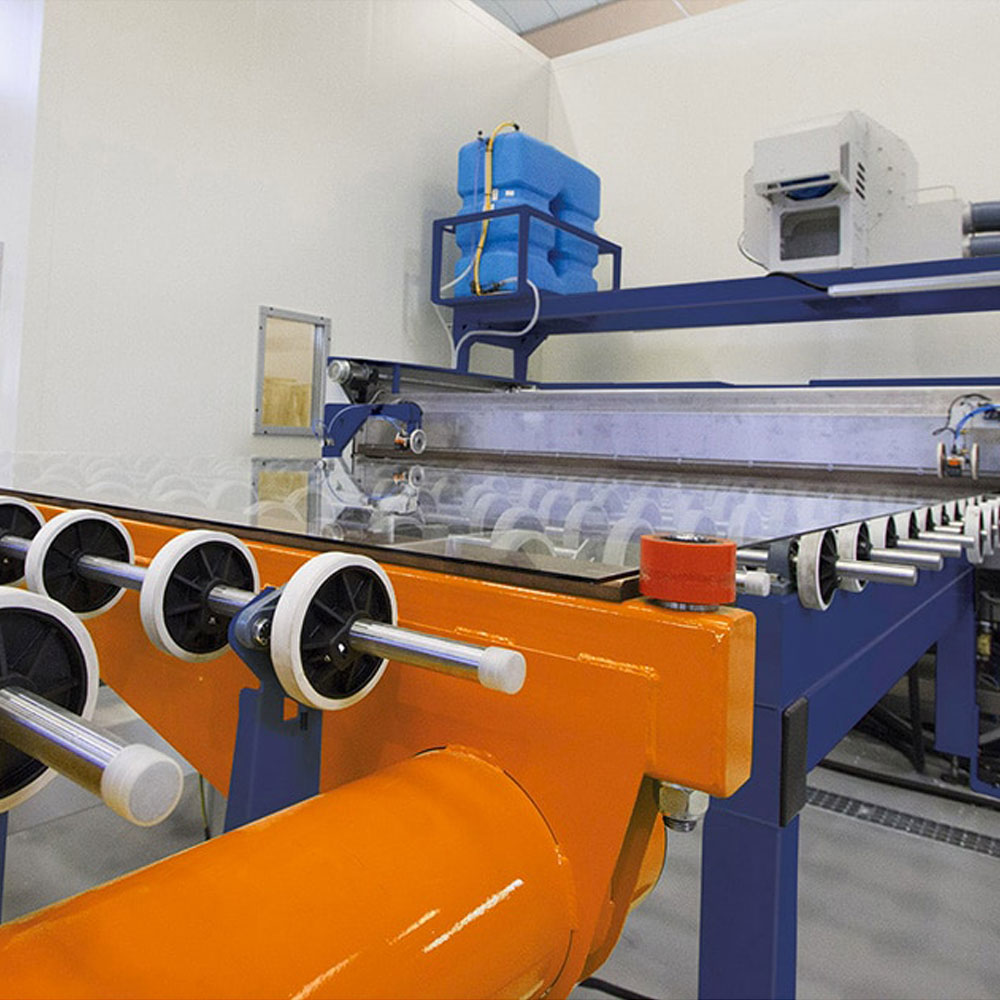
Before being assembled and entering the clean room, the glass must be washed. The washing machine can be configured with different air knives and brushes according to the client’s requests. In addition, lamps can be mounted on the background at the outlet for an accurate visual check by the operator on the quality of the glass, and this passage area is closed by removable plexiglass panels: if they are removed, the washing machine can work as stand-alone independently from the rest of the system.
ASSEMBLY
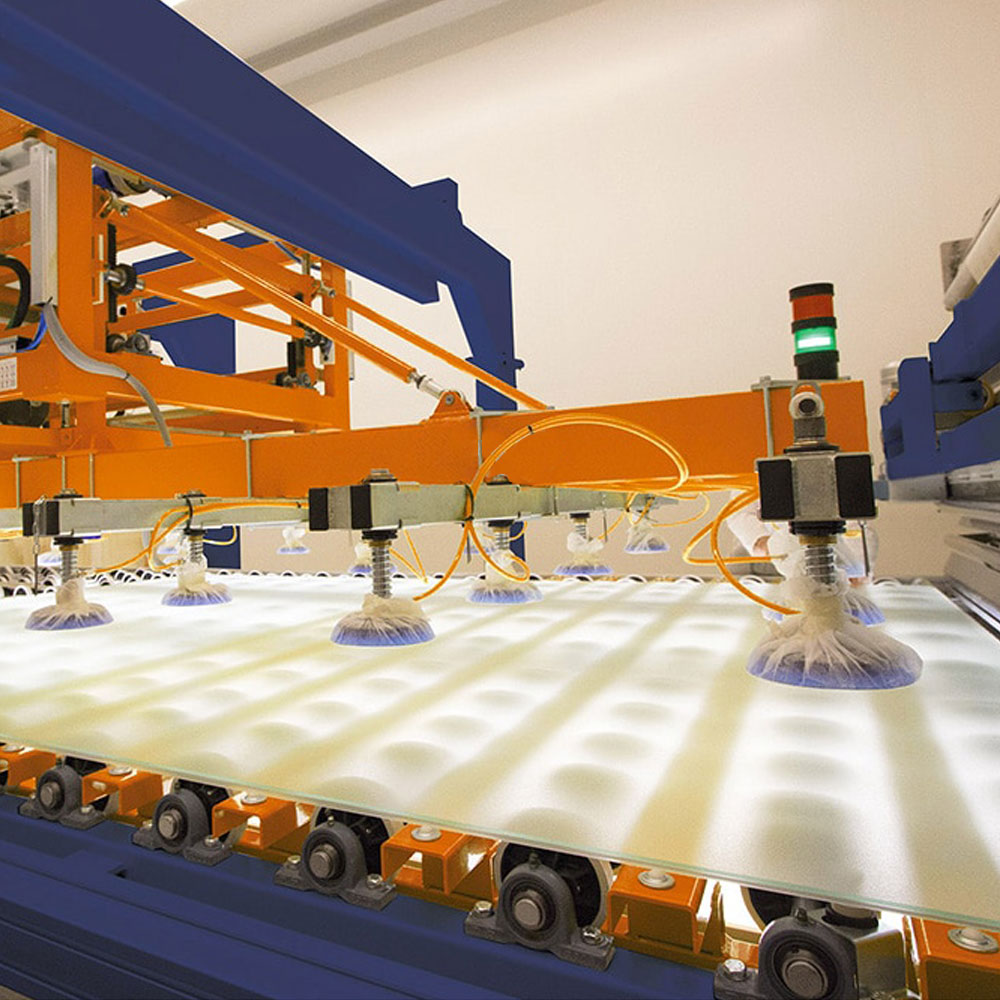
In this phase the glass has entered the clean room where it is first aligned (front and side) and then moved to be assembled. A suction cup carrier mounted on overhead rails transfers the glass onto the assembly table. The carrier is designed to be fast and robust, with particular attention to the suction cup system: they are made of special rubber that leave no trace on the glass, are equipped with a self-closing valve to adjust to the size of the glass and can handle glass up to jumbo dimensions. The positioning of the glasses following the first one, for the creation of the sandwich, takes place in a precise and automatic way.
UNWINDING
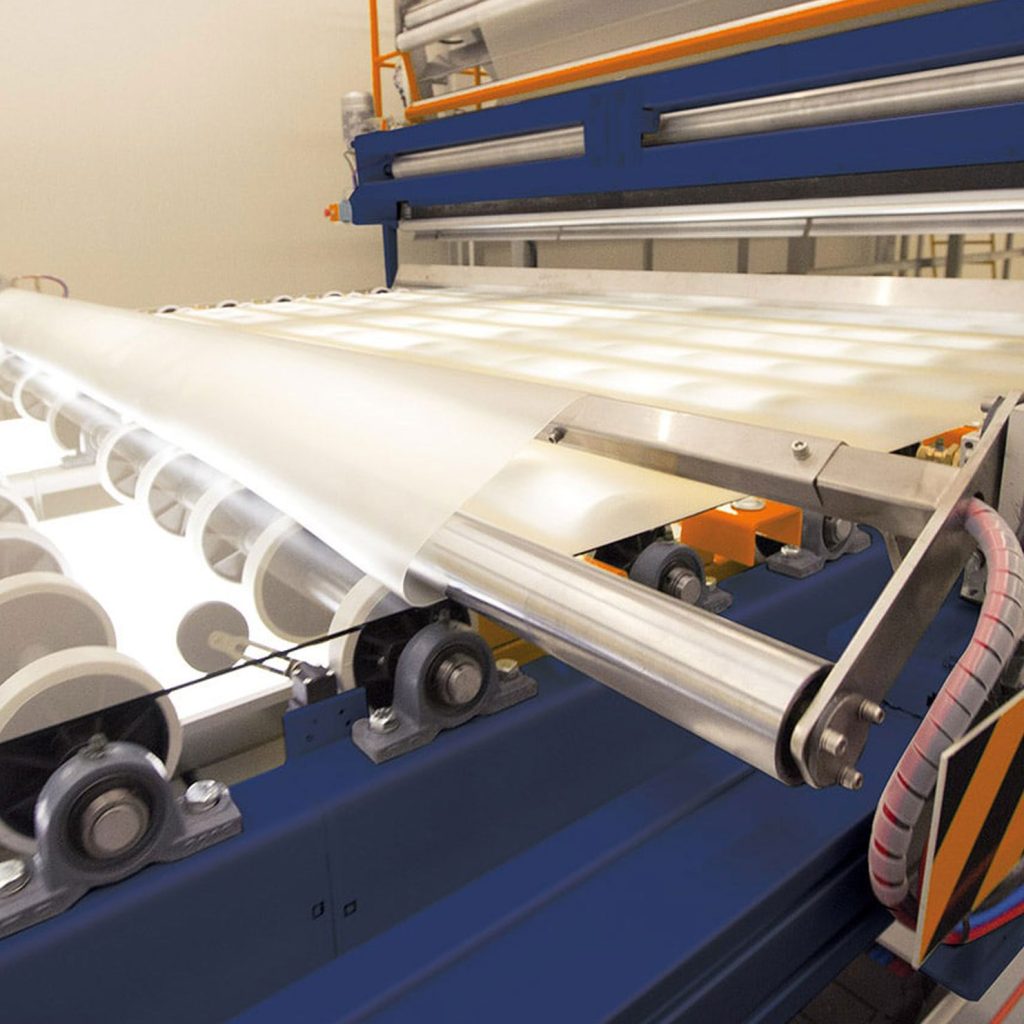
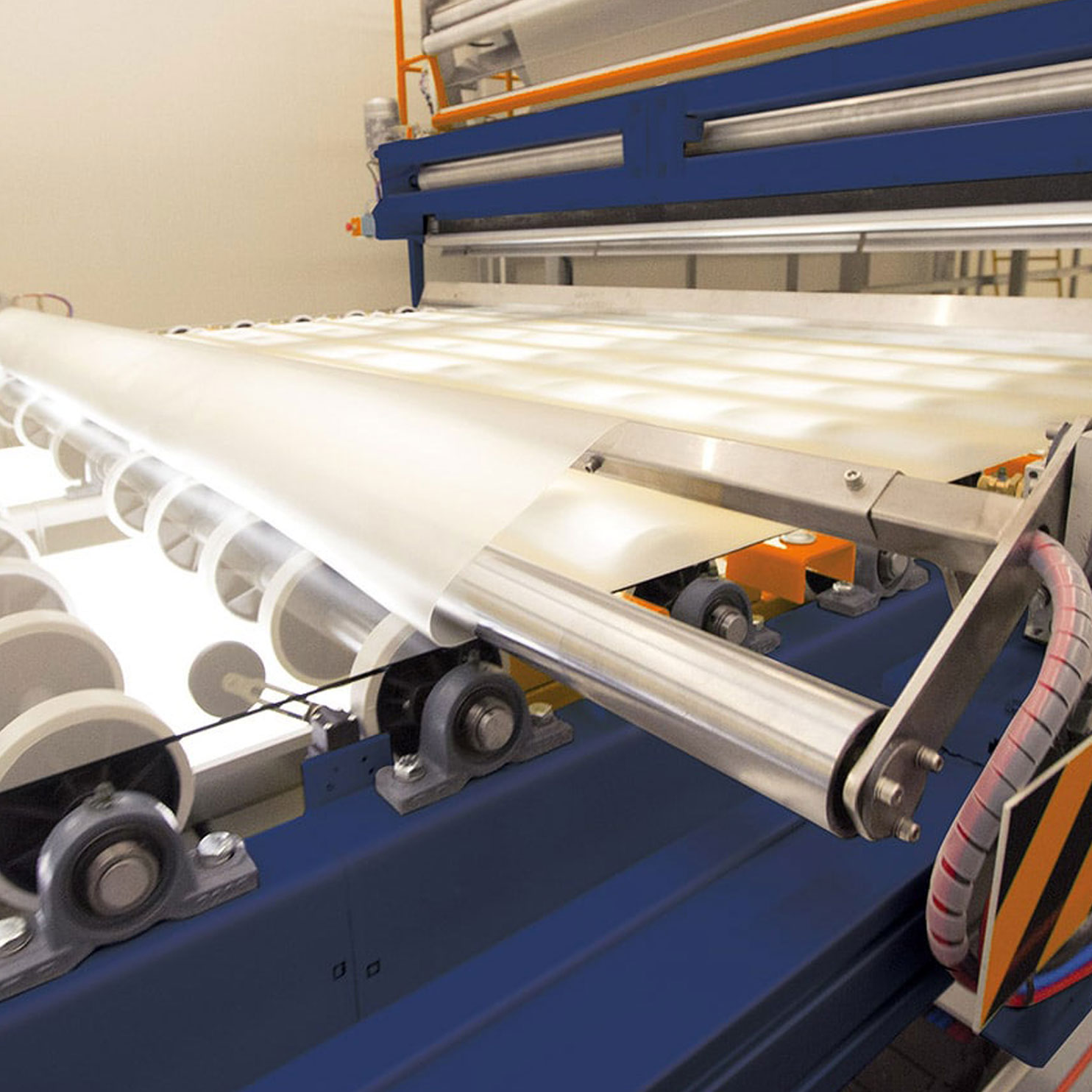
This structure houses the rolls of film to be used in the creation of the laminate sandwich and the area is used for unwinding, laying and trimming. Different quantities of rolls can be accommodated in order to quickly change the type of film according to the customer’s needs and the required processes. The film can be laid and cut manually, semi-automatically (servo controlled) or laid, cut and trimmed automatically.
OVEN
The two ovens are equipped with infrared lamps whose power varies according to the thickness of the panel. To reduce consumption, the lamps turn on only when the panel enters the oven section. As needed, in addition to radiation, the oven can work in convection, being able to modulate heat more efficiently and with reduced consumption: this is the operating principle of the new HRC oven. The two nip rollers remove the air bubbles from the panel; their pressure on the glass can be adjusted according to the thickness of the panel.
OFF LOADING
The off loading phase, just like the loading, can be done manually or automatically with the aid of robots.